Get Started with mesibo
mesibo enables you to add highly scalable, real-time messaging, group chat, voice and video calls, conferencing, and chatbots to your mobile and web applications — with a clean, powerful API you can learn in minutes.
In this guide, we will build a fully functional app with the following capabilities in under an hour:
- One-to-one and Group Messaging
- Voice and Video Calls
- Group Calls (Conferencing)
- Reading Messages from the Database
- Setting User Profiles
- Synchronizing Phone Contacts
- And more
Download Source Code
The complete source code for this tutorial is available on mesibo’s GitHub repositories. We recommend cloning it now, opening it in your development environment (Android Studio, Xcode, VS Code, etc.), and following along as you work through each section.
$ mkdir mesibo
$ cd mesibo
$ git clone https://github.com/mesibo/samples.git
Understanding mesibo Applications
Before you can do anything with mesibo, you need to define your project on the mesibo console. In mesibo, this is called an Application. A mesibo Application is a logical container — not tied to any specific platform or client. A single Application spans all your platforms (Android, iOS, Web, etc.) and holds everything associated with your service:
- All your users and their access tokens
- All your groups and membership rules
- Push notification settings (APNs, FCM)
- Webhooks, configuration, and other app-level settings
Think of it as the server-side representation of your product. Whether you ship on mobile, web, or desktop, they all belong to the same mesibo Application and share the same user base.
Each Application is identified by an App Token — a secret key used exclusively by your backend servers to manage users, groups, and other resources via the mesibo Backend APIs.
mesibo API Types
mesibo provides two type of APIs:
Backend APIs — REST-based APIs used exclusively by your backend servers to create and manage users, groups, and application settings. These APIs require the App Token. See the mesibo Backend API reference for details.
Real-time APIs — Client-side APIs used by your Android, iOS, Flutter, Web, C++, and Python apps to enable real-time communication — one-to-one messaging, group messaging, voice and video calls, and more. Each user of your app authenticates with a user access token, generated by your backend server using the Backend API.
Using mesibo essentially involves using the Backend API to create users and access tokens, and then initializing and using the Real-time APIs on your client side with those access tokens.
Create Your Application and Obtain the App Token
To get started, log in to your mesibo console.
Click New Application and give it a name — for example, FirstApp. This Application will represent your product across all platforms.
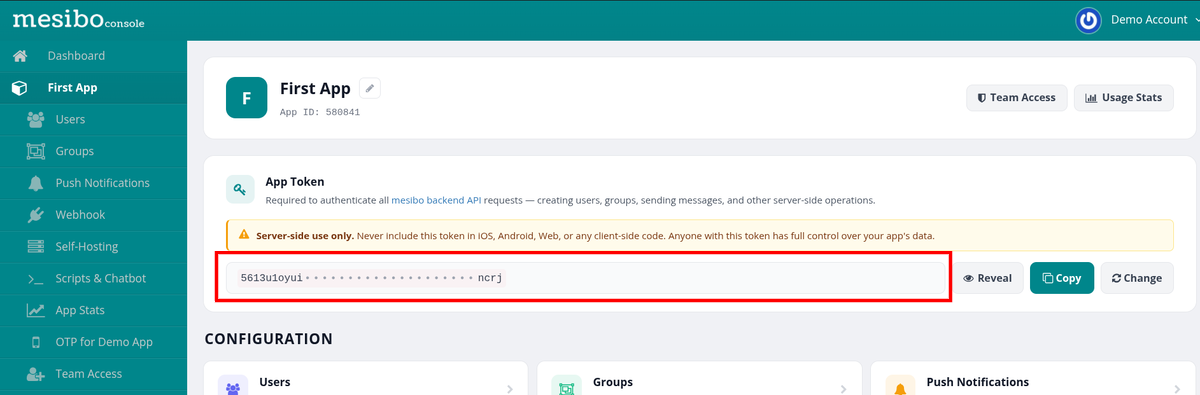
Once the Application is created, copy the App Token from the dashboard. It will look similar to this:
5613u1oyuihd9ld0o0pxqx9h80jjqfu9ipul4l00fnyk4u20b55bfxfecbcmncrj
Keep this token secure. You will use it in your backend server to generate user access tokens — one per user — which are what your client apps use to authenticate with mesibo.
Important: The App Token is a server-side secret. Never embed it in client applications (Android, iOS, Flutter, JavaScript, etc.). It must only be used on your backend.
Next, we will create user access tokens and build your first mesibo app with messaging and calls.